


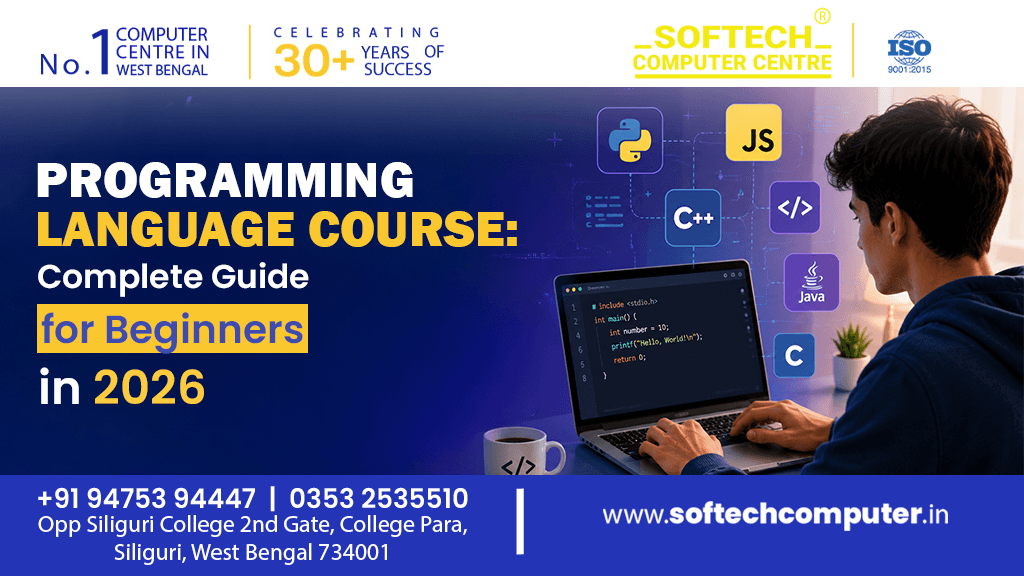
Programming Language Course: Complete Guide for Beginners in 2026
Thinking about learning a programming language course in 2026? Good move. Programming is one of the most in-demand, highest-paying skills you can build right now – and it is far more beginner-friendly than most people expect.
This complete guide explains everything you need to know about choosing the right programming language course in 2026, including course fees, career opportunities, certifications, programming languages, and how beginners can start confidently.
What is a Programming Language?
A programming language is a way of giving instructions to a computer. These instructions help create websites, mobile apps, software, games, AI tools, and automated systems.
Popular programming languages include:
- Python
- Java
- C
- C++
- JavaScript
- PHP
- SQL
Each language serves different purposes, but learning the fundamentals makes switching between languages much easier.
Why a Programming Language Course Matters in 2026
It is technology today that does everything. Apps. Websites. Automation. AI tools.
Behind all of it? Code.
A programming language course is an educational program where you learn a skill that is the basis of this entire world. Know it, and you’re not following the trend. You have built the future; it is YOU.
Companies are looking for coding people. Startups need them. They are necessary not just for tech businesses. The demand continues to increase year after year.
But the big techs are not the only ones. Small businesses must have websites. Schools need apps. Healthcare facilities require automation. Programming abilities have expanded to nearly all sectors imaginable.
What You Will Learn in a Programming Language Course
Most people imagine programming courses as rooms full of confusing symbols and error messages. The reality is far more structured – and far more achievable – than that.
A well-designed beginner programming course teaches you how to think logically first, and how to write code second. Here is what a solid course covers:
Basic syntax and logic: Every programming language has rules, like grammar in any spoken language. You learn those rules one at a time, starting with the simplest building blocks.
Variables, loops, and functions: These are the three fundamental tools every programmer uses, regardless of language. Once you understand them, everything else clicks.
Problem-solving techniques: The most valuable thing a programming course teaches is not the language itself. It is how to break a complex problem into smaller, solvable steps.
Real projects, not just theory: Good courses don’t just show you examples. They give you assignments that mirror actual development work. You build something, it breaks, you fix it, and you learn more in that moment than in any lecture.
Debugging and testing: Knowing how to find and fix errors is what separates a trained programmer from someone who just watched tutorials. This is where confidence gets built.
Think of it like learning to drive. The first few sessions feel overwhelming. By the fifth, you stop thinking about the gear and start thinking about the road. Programming works exactly the same way.
Which language should you learn first?
Python. No debate.
Python reads almost like plain English. It is beginner-friendly, yet powerful enough for web development, data science, automation, and AI. It is consistently ranked the most popular programming language globally by the TIOBE Index, and the most enrolled course at Softech Computer Centre in Siliguri.
Other options worth knowing:
Java: Ideal for enterprise IT and Android development. Slightly harder to start with but widely hired for corporate roles.
C++: Older but still in strong demand for gaming, embedded systems, and performance-critical software.
JavaScript: JavaScript is Unavoidable if web development is your specific goal.
For most beginners, start with Python. Everything else becomes easier after that.
Programming Course Fees: What Should You Expect?
Let’s talk about money. No confusion.
Programming course fees vary depending on the institute, the language, and course depth. Generally, they’re far more affordable than a full college degree.
Here’s what usually affects the price:
- Course duration
- Live classes vs. recorded content
- Certification included or not
- Beginner vs. advanced level
At Softech Computer Centre, fees stay transparent. No hidden charges. No surprises halfway through.
Online or offline - which format works better?
Both options work. It depends on your style.
Computer programming classes online offer flexibility. Learn from home, at your own pace. Great for working professionals or students juggling other commitments.
Offline sessions offer something different. Direct mentor interaction. Instant doubt-clearing. A structured, disciplined routine.
Some students prefer one. Some prefer both. Either way, the goal stays the same: real skill, real confidence.
Programming Certificate Course: Is It Worth It?
Short answer: yes.
A programming certificate course adds real weight to your resume. It shows employers you didn’t just dabble. You committed. You finished. You proved your skill.
Recruiters notice this. In competitive job markets, a certificate can be the small edge that gets your resume noticed first.
It also builds personal confidence. Finishing what you started, proving you can commit to a skill from start to end – that matters just as much as the paper itself.
Career After Programming Course: What's Next?
This is the part that matters most, and the answer is wider than most beginners expect.
After completing a programming language course, the most common career paths in India include:
Software developer: average fresher salary ₹3.5 to 6 LPA depending on the company and city. The most direct path for someone who completes a structured programming course.
Web developer: Front-end, back-end, or full stack. Average fresher salary ₹3 to 5 LPA. Freelancing is also a strong option, with many developers earning project-based income alongside or instead of a salaried role.
Data analyst: Average salary ₹4 to 7 LPA at entry level, growing significantly with experience. Python knowledge is the primary technical requirement for most data analyst roles.
Automation engineer: One of the fastest-growing roles as companies seek to reduce manual work through scripted automation.
Freelance developer: Many Softech Computer Centre graduates in Siliguri begin taking real client projects within months of finishing their course. Freelancing requires no job application – just a portfolio and the willingness to start small.
Programming skills also travel across industries. Coders work in finance, healthcare, e-commerce, education, gaming, and logistics. Learn once, and the opportunities expand in every direction.
Can non-IT students learn programming?
Absolutely – and this is one of the most important things to understand before you talk yourself out of enrolling.
Commerce graduates, arts students, and career-changers from completely unrelated fields complete programming courses and enter IT careers every year.
Programming is built on logic and practice – not your academic background. The only real requirement is showing up consistently. A well-structured beginner course meets you exactly where you are.
How to Choose the Right Programming Language Course?
Not all courses are equal. Here’s what to check before enrolling:
- Experienced trainers, not just recorded videos
- Hands-on projects, not just slides
- Small batch sizes for real attention
- Placement or career support after completion
- Clear, transparent fee structure
A strong course checks every one of these boxes. Anything less, and you’re likely settling for less than you deserve.
Why Choose Softech Computer Centre for Your Programming Language Course
The Softech Computer Centre keeps things practical. Real coding, from day one. Real mentors, not just playback screens.
Every course here is built around actual projects. You don’t just learn concepts. You apply them, test them, and fix them – exactly like a real developer would.
Add in flexible batch timings, beginner-friendly pacing, and genuine career guidance, and it’s easy to see why so many students start their coding journey right here.
Frequently Asked Questions (FAQ)
1. Do I need any prior experience to start?
2. Which programming language should I learn first?
3. How long does a programming course usually take?
4. Can non-IT students learn programming?
5. Will I get a certificate after completion?
Ready to Start Coding?
2026 is the perfect year to learn a real, in-demand skill.
A programming language course isn’t just another certificate. It’s a career move. A confidence boost. A skill that keeps paying off for years.
Get in touch with the Softech Computer Centre, the best computer training institute. Ask about batches. Ask about fees. Ask anything. Your coding journey starts with one simple step – take it now.
The best time to start was yesterday. The next best time is today. Don’t overthink it – enroll, show up, and let the momentum carry you forward.