


Softech Computer Education

soffeducollegecen

YouTube Taught Me Computer. Here’s What It Missed

YouTube Taught Me Computer. Here’s What It Missed Be honest. You have watched at least one programming tutorial on YouTube and told yourself you were learning to code. Maybe you followed along. Maybe the code worked while the video was playing. Then you closed the tab, opened a blank file, and had no idea where to start. That is not a problem. That is a YouTube problem. YouTube is genuinely useful. It is free, accessible, and covers almost every topic imaginable. But there is a specific kind of learning it cannot replicate – and that gap becomes very obvious the moment you sit in a real job interview or try to build something from scratch without a video playing in the background. This is exactly what students discover when they walk into the Softech Computer Centre – a Siliguri Computer Centre with over 30 years of training experience, ISO 9001:2015 certified, and 50+ job-oriented courses built around one goal: making you genuinely capable, not just occasionally functional. What YouTube Actually Gives You Let us be fair before being critical. YouTube has genuinely changed how people access information. A student in Siliguri can watch a tutorial from an MIT professor, follow a Python course from a developer in San Francisco, or learn Photoshop from a designer in London – all for free, in their own time. That is remarkable. And for picking up surface-level knowledge or exploring whether a subject interests you, it works well. The problem starts when you try to go further. What YouTube Consistently Misses It cannot ask you a question. Watching someone else solve a problem is not the same as solving one yourself. YouTube shows you the answer. A good instructor makes you find it. That difference is everything when you are sitting in a technical interview and there is no video to pause. It cannot tell you when you are wrong. You can watch a coding tutorial, follow every step, and still be developing habits that will slow you down for years. Bad logic. Sloppy structure. Shortcuts that break under pressure. YouTube has no way of spotting this. An experienced instructor does – and corrects it before it becomes a pattern. It has no structure built for you. A YouTube playlist is not a curriculum. It is a collection of videos someone uploaded in a loose sequence. There are gaps, inconsistencies, and no guarantee that what you learn in video three actually prepares you for video seven. A proper computer course in Siliguri is sequenced deliberately – each concept building on the last. It cannot simulate a real deadline. Professionals work under pressure. They debug code when something breaks at the wrong moment. They deliver projects by a specific date. YouTube teaches you in a consequence-free environment where nothing is ever actually due. That comfort disappears the moment you enter a workplace. It does not prepare you for interviews. The gap between knowing a concept and explaining it clearly under pressure is significant. Most YouTube learners discover this the hard way. Structured training at a computer centre in Siliguri includes mock tests, problem-solving sessions, and the kind of repeated practice that makes interviews feel familiar rather than terrifying. The Specific Things Students Come to Softech Already Knowing – And Still Need to Relearn This comes up more often than you might expect. Students arrive at Softech Computer Centre having spent months on YouTube. They know the vocabulary. They have watched hours of content. But when asked to write a programme from scratch, explain why their code works, or fix a bug they have not seen before – the gaps surface quickly. It is not their fault. YouTube optimises for views, not outcomes. What structured training fixes: Foundation gaps – concepts that were skipped or glossed over in tutorials because they are not exciting enough to make a good video. Object-oriented programming. Data structures. Exception handling. These are not glamorous topics. They are the ones every employer tests. Applied thinking – the ability to take a problem you have never seen before and work through it systematically. This is built through practice, feedback, and repetition. Not passive watching. Real project experience – a project you built yourself, solved yourself, and can explain confidently in an interview. Not a project you replicated from a screen while someone walked you through every line. What a Proper Computer Centre in Siliguri Offers Instead At Softech Computer Centre, the difference is not about having fancier videos or a better studio. It is about what happens between you and an instructor in a room. Courses built around job outcomes – whether you are learning Tally, joining coding classes in Siliguri, enrolling in an AI course in Siliguri, or starting with computer basics – every course at Softech is designed around what employers are actually hiring for, not what makes an engaging tutorial. Instructors who have worked in the industry – not just people who are good at explaining things on camera. People who have solved real problems, worked on real projects, and know what a hiring manager is looking for because they have been on both sides of that table. Doubt-clearing that actually works – when you are stuck, you raise your hand. The problem gets resolved before you move on. No comment section. No waiting for a reply that may never come. No rewatching the same five minutes hoping the answer appears. Structured curriculum with no gaps – every concept is sequenced deliberately. What you learn in week two prepares you for week three. Nothing is assumed. Nothing is skipped because it is not interesting enough to film. A batch of peers learning alongside you – accountability, healthy competition, and the experience of working through problems with other people. This is closer to what a real workplace feels like than anything you experience alone with a laptop. Who Should Stop Relying on YouTube Alone If any of these sound familiar, structured training at a Siliguri Computer Centre is the

YouTube Taught Me Computer. Here’s What It Missed Read More »
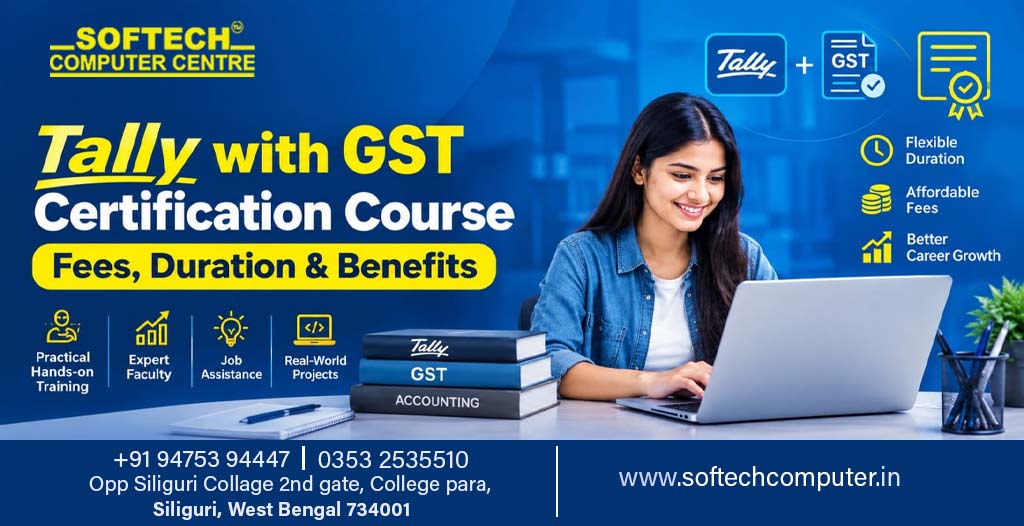
Tally with GST Certification Course: Fees, Duration & Benefits

Tally with GST Certification Course: Fees, Duration & Benefits Tally with GST has become one of the most sought-after skills in the current job market for accountancy and finance. Since GST is now mandatory for virtually all registered businesses in India, businesses are looking out for people who have the capability to maintain invoices, tax, and accounts through the Tally software. No matter whether you’re a commerce graduate, an existing professional, or even planning a career change, taking up this course will prove to be highly beneficial for your career. Why Should You Learn Tally with GST Today? Before GST came into existence, companies used to keep separate accounts and tax records through out-of-date and manual methods. However, the latest development in accounting software allows you to maintain both your accounts and taxes through one program, and the best software available on the market is Tally. Through learning this software, you will be able to prepare invoices, file GST returns, do inventory management and payrolls, among others. Most companies operating in India use Tally to keep daily records of their accounts. Therefore, the knowledge of this software is highly valued among local job applicants and even freelancers in the field. What Is the Duration of the Tally GST Course? The certification course typically runs for 2 to 3 months, depending on the batch type and the student’s learning pace. At Softech Computer Centre, we offer both regular and fast-track batches to suit different schedules: Regular batch: 3 months, with classes 3–4 days a week, ideal for students who want in-depth, practical learning Fast-track batch: 6–8 weeks, suited for working professionals who need quicker certification Weekend batch: For those balancing a job or college alongside the course Each batch includes a mix of theory and hands-on practice, so students aren’t just learning concepts – they’re actually working on real invoices, ledgers, and GST filing scenarios by the end of the course. What Topics Does the GST Return Filing Course Cover? A good Tally with GST course should go beyond just software navigation. At Softech Computer Centre, our curriculum covers: Basics of accounting – journal entries, ledgers, trial balance, and financial statements Tally fundamentals – company creation, voucher entry, inventory management GST concepts – CGST, SGST, IGST, and how they apply to different transactions GST return filing – GSTR-1, GSTR-3B, and reconciliation processes E-way bills and e-invoicing – generating and managing digital documentation Payroll management – salary processing, PF, and ESI compliance within Tally Bank reconciliation and MIS reporting – practical skills employers actually look for This structure ensures that by the time you finish the program, you’re not just familiar with the software – you’re job-ready. What Are the Tally Course Fees in Siliguri? One of the most common questions students ask is about the fees for the certification. Pricing can vary depending on the institute, batch type, and course depth, but at Softech Computer Centre, we’ve kept our fees affordable without compromising on quality. We believe skill development shouldn’t come with a heavy price tag, especially for students and early-career professionals in Siliguri and North Bengal. We also offer: Flexible installment options for students who need it Discounts for group enrollments (useful for college batches or office teams) Free demo classes so you can experience our teaching style before enrolling For the most updated fee structure, we recommend visiting our centre directly or calling us, since fees are occasionally revised based on syllabus updates from GST regulations. What Are the Career Benefits of GST Certification? Here’s why this course is worth the investment of your time and money: Strong job market demandAlmost every accounting, billing, or finance-related job posting today mentions Tally as a required skill. Certification gives you a competitive edge over other candidates. Better salary prospectsProfessionals with GST and accounting software knowledge often command higher starting salaries compared to those with only manual bookkeeping skills. Self-employment opportunitiesOnce certified, you can offer freelance accounting and GST filing services to small businesses – a growing need as more shops and startups register under GST. Useful for business ownersIf you run your own business, this skill lets you manage your own accounts and returns instead of relying entirely on a hired accountant, saving you money in the long run. Career growth across industriesFrom retail and manufacturing to service-based businesses, every sector needs people who understand GST-compliant accounting, making this a versatile skill rather than a niche one. Who Should Enroll in This Accounting Course? This course is suitable for: Commerce students (B.Com, M.Com) looking to add practical skills to their degree Job seekers applying for accountant, billing executive, or data entry roles Small business owners who want to handle their own GST filing Working professionals in finance departments looking to upgrade their skillset Anyone planning to start a freelance accounting or bookkeeping service You don’t need a strong accounting background to start – our course is structured to take Why Choose Softech Computer Centre? Softech Computer Centre is a well-established computer training centre in Siliguri, known for its practical, student-focused approach to teaching. Our trainers bring real industry experience, which means students don’t just learn theory – they get insights into how accounting is actually handled in real businesses. Here’s what sets us apart: Experienced faculty with hands-on industry background Small batch sizes for personalized attention Practical, project-based learning rather than just lecture-based teaching Placement assistance and guidance for interested students Convenient location, flexible timings, and ongoing student support even after course completion We understand that every student learns differently, which is why our teaching methods focus on repetition, real case studies, and one-on-one doubt-clearing sessions rather than rushing through the syllabus. Final Thoughts Tally Training in GST will give you something more than just another certificate on your CV – it is learning a skill that is in high demand from all companies nowadays. If you aim to get a secure position as an accountant, start working as a freelancer, or organize business accounts better, you will have all

Tally with GST Certification Course: Fees, Duration & Benefits Read More »

Is Java Course Enough to Get a Software Job?

Is Java Course Enough to Get a Software Job? Most students ask this question before enrolling somewhere. Very few get a straight answer. So here it is. Yes – a Java course can get you a software job. But not because you sat through classes and collected a certificate. Because you learned to think in code, built real things with it, and walked into an interview knowing how to solve problems on the spot. That is what actually gets people hired. Not the paper. The proof. This blog covers what Java genuinely opens up in 2026, what you need alongside it, and how students in Siliguri are learning it in a way that actually leads somewhere. Softech Computer Centre has been training students across North Bengal for over 30 years. ISO 9001:2015 certified. 50+ courses. If you are serious about a software career, read this before you enrol anywhere. Why Java is still one of the most valuable skills in 2026 Every few years, someone declares Java dead. Every few years, the hiring data says otherwise. Java has ranked in the global top three programming languages for over two decades according to the TIOBE Index. Not out of habit – because the systems built on it are still running, still growing, and still need developers. In India, Java is actively hired across enterprise IT, banking software, Android development, and government technology projects. Four reasons it has stayed that way: It works everywhere – Java’s platform independence means code runs across devices and operating systems without being rewritten from scratch. It runs Android – India has over 600 million Android users. Every Android app is built in Java or Kotlin, which sits on Java’s foundation. It powers large-scale systems – banking platforms, insurance software, hospital management tools. These are not being replaced anytime soon. Government IT tests it – central and state government roles specifically look for Java knowledge. For public sector aspirants, it is non-negotiable. Java is not the newest language. It is one of the most reliable career bets in 2026. What a Java Course in Siliguri Actually Teaches You A well-structured Java course in Siliguri at Softech Computer Centre does not just walk you through syntax. It builds the way you think about problems. Here is what the course actually covers: Core Java fundamentals – variables, data types, operators, control flow, loops, and functions. The building blocks that everything else depends on. Most students underestimate how important getting these right actually is. Object-oriented programming (OOP) – Java is fundamentally an object-oriented language. Classes, objects, inheritance, polymorphism, and encapsulation are not just concepts to memorise – they are how real-world software is structured. Employers test this directly in interviews. Exception handling and debugging – knowing how to write code is one thing. Knowing how to find out why it broke and fix it quickly is what actually makes you useful on a development team. Collections and data structures – arrays, lists, stacks, queues, and maps. These are the tools Java developers use to store and manipulate data efficiently. Interview questions almost always touch this area. Java for real projects – at Softech, students do not finish the course having only written code exercises. They work on actual projects that mirror real development tasks – the kind of work that builds a portfolio worth showing. Interview preparation – mock tests, coding challenges, and the specific problem types that Java interviews in India consistently test. This is where confidence gets built or broken. So is Java Alone Enough? Honestly – Java is a strong foundation. But the students who get hired fastest are the ones who pair it with a few complementary skills. Here is what employers are looking at alongside Java knowledge in 2026: SQL and database basics – almost every Java application connects to a database. If you cannot write a basic SQL query, retrieve data, or understand how tables relate to each other, you are missing a skill that appears in nearly every job description for Java developers. Basic understanding of frameworks – Spring and Hibernate are the two most common Java frameworks used in enterprise development. You do not need to master them as a beginner, but knowing what they are and how they work puts you ahead of candidates who have never heard of them. Version control with Git – every professional development team uses Git. Not knowing it is a red flag in any software interview. The basics take a few days to learn and immediately make your resume more credible. Problem-solving and logical thinking – this cannot be taught in a day, but it can be built through consistent coding practice. Platforms like HackerRank and LeetCode are where most Indian IT companies draw their interview questions from. Regular practice here matters. Communication and teamwork – this sounds soft, but it is genuinely tested. Developers work in teams. They explain technical decisions to non-technical stakeholders. They review each other’s code. Candidates who can communicate clearly in an interview consistently have an edge over those who cannot. None of these are as hard to build as they sound. A good coding course gives you the foundation. Consistent practice builds the rest. What the Java Job Market Looks Like in India Right Now The numbers are worth knowing before you invest time and money in a course. According to industry data, Java developer roles in India grew by over 22% between 2022 and 2024. Entry-level Java developers earn between ₹3 to 6 LPA on average. Mid-level developers with two to three years of experience move into the ₹8 to 15 LPA range. Senior Java architects at large enterprises regularly earn above ₹25 LPA. The demand is spread across multiple sectors: Banking and financial services – HDFC, ICICI, Infosys BFS, and dozens of fintech startups use Java as their primary backend language. This sector alone accounts for a significant share of Java hiring in India every year. IT services companies – TCS, Wipro, Infosys, HCL, and Cognizant

Is Java Course Enough to Get a Software Job? Read More »

Why Coding Is Not Just for Engineers Anymore

Why Coding Is Not Just for Engineers Anymore Not long ago, if you said you were learning to code, people assumed you were becoming a software engineer. Parents questioned it. Teachers raised eyebrows. Friends thought it was too technical for anyone outside a computer science degree. That assumption is outdated – and in 2026, it is also expensive to hold on to. Coding is no longer a specialist skill reserved for engineers. It is becoming a working advantage across every industry, every job role, and every career stage. And the students who recognise this early are the ones moving ahead. Softech Computer Centre has been training students in North Bengal for over 30 years. ISO 9001:2015 certified. 50+ courses. This guide covers the real scope of a coding course in 2026 – who it is for, what it leads to, which languages matter, and what to look for before you enrol. Coding is Everywhere Now – Not Just in Tech Companies Marketing teams use code to automate campaigns. Finance professionals use it to analyse data in minutes instead of hours. Healthcare companies use it to build patient management tools. Small businesses use basic scripts to eliminate hours of repetitive manual work every week. India’s tech industry is projected to reach $350 billion by 2026 according to NASSCOM. But the roles being created are not all sitting inside IT companies. They are spread across banking, retail, education, logistics, healthcare, and government – and they increasingly reward people who understand code, regardless of their job title. The demand is not slowing down. It is accelerating. And the gap between people who can code and people who cannot is widening every year. What is The Scope of a Coding Course in 2026? The scope is wider than most students expect. Here is what a coding course actually leads to: Software development – The most direct career path. Building apps, tools, and systems for companies of every size. One of the most consistently hired-for roles in India, with entry-level salaries ranging from ₹3.5 to 6 LPA. Web development – Every business needs a website. Every website needs someone who can build and maintain it. Front-end, back-end, or full stack – all three have strong demand and solid freelance potential alongside salaried work. Data science and analytics – Demand for data roles in India grew over 45% between 2022 and 2024. Python is the primary language. Entry-level data analyst salaries average ₹4 to 7 LPA, growing significantly with experience. AI and machine learning – Almost every AI role starts with a coding foundation. The field is growing faster than colleges can produce trained candidates and shows no signs of slowing. Automation and scripting – Writing code that handles repetitive tasks automatically. Manufacturing, finance, and logistics companies are actively paying for this skill right now. Freelancing – Many coding course graduates begin taking real client projects within months of finishing. Web development, app building, and automation scripts are among the most in-demand freelance skills in India. Government IT roles – Diplomas like DCA and PGDCA, which include coding modules, fulfil the computer certificate requirement in many government job applications across India. Top Coding Languages by Scope in 2026 Not every language carries the same weight. Here is where each one actually stands: Python – The most popular programming language globally for three consecutive years according to the TIOBE Index. Beginner-friendly, versatile, and relevant across web development, data science, AI, and automation. Demand for Python developers in India has grown over 30% year on year. For most beginners, this is the right starting point. JavaScript – Powers the interactive layer of almost every website. Essential for web development and increasingly used on the back end through frameworks like Node.js. If building websites is your goal, JavaScript is unavoidable. Java – Slightly harder to pick up than Python but widely used in enterprise software, Android development, and government IT systems. Strong corporate demand and well-paying mid-level roles. C++ – Older but far from irrelevant. Gaming, embedded systems, and performance-critical software still rely on it heavily. Companies pay well for people who know it properly. SQL – Essential alongside any primary coding language for anyone working with data. Almost every data-related role requires it. Learn SQL alongside Python and your career options expand significantly. For beginners, start with Python. Everything else becomes considerably easier once you understand how to think logically in code. Who Should Actually Do a Coding Course? More people than currently think it applies to them. Students after 12th – A coding course before or alongside college builds a practical skill set most graduates simply do not have. It makes you stand out before your degree is even complete. Commerce and arts graduates – Python is designed to be readable and logical, not mathematically complex. If you can follow a process and think step by step, you can learn to code. Background does not determine ability here. Working professionals – Stuck in a role with limited growth? Coding skills are one of the most effective ways to move into higher-paying IT roles without starting from scratch. Non-technical students – A well-structured beginner course meets you exactly where you are. No prior technical knowledge required. Consistent practice is the only real requirement. Business owners – Understanding code helps you build smarter systems, communicate better with developers, automate repetitive processes, and make sharper technology decisions without depending entirely on external vendors. What to Look for Before You Enrol in a Coding Course The difference between a course that gets you hired and one that just adds a line to your resume is almost entirely in the quality of practical training. Before you sign up anywhere, check for: Hands-on projects from day one – you learn to code by writing code, not by watching someone else write it. If the course is mostly slides and recorded videos, move on. Instructors with real industry experience – trainers who have worked as developers teach differently from those who have only

Why Coding Is Not Just for Engineers Anymore Read More »

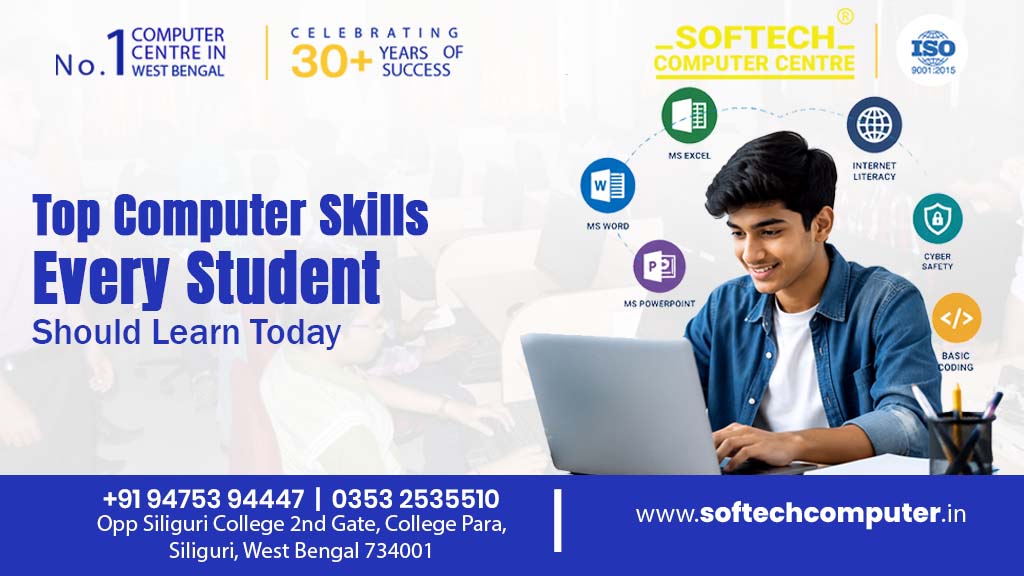
Top Computer Skills Every Student Should Learn Today

Top Computer Skills Every Student Should Learn Today Here is something no one tells you clearly enough in school. Your degree opens the door. Your skills decide whether you walk through it. In 2026, employers across every industry – IT, finance, healthcare, retail, education – are not just asking what you studied. They are asking what you can do. And the students who have built real computer skills are consistently the ones getting shortlisted, called back, and hired first. The good news? These skills are learnable. None of them require a technical background. And most of them can be built in a few months with the right training. Here is exactly what matters – and why. 1. Microsoft Office and productivity tools Before anything else, get this right. MS Word, Excel, and PowerPoint are used in almost every workplace in India – from small businesses to large corporations. Yet most students who claim to “know Office” can barely do more than type a document or make a basic slide. The students who stand out know Excel formulas, data sorting, pivot tables, and professional formatting. They know how to build a presentation that communicates clearly, not just one that looks busy. This is not a glamorous skill. But it is the one that comes up in literally every job, every day. 2. Basic Coding and Programming You do not need to become a software engineer to benefit from knowing how to code. Even basic programming knowledge – understanding logic, writing simple scripts, knowing how software thinks – changes how you approach problems. It makes you more valuable in roles that have nothing to do with development. For students who want to go deeper, Python is the best starting point in 2026. It is beginner-friendly, widely used, and relevant across data science, automation, AI, and web development. According to the TIOBE Index, Python has been the most popular programming language globally for three consecutive years. Start with the basics. Build one small project. The confidence that follows is worth more than any certificate. 3. Internet Research and Digital Literacy This sounds obvious. It is not. Most students can search Google. Very few know how to evaluate sources, cross-check information, use advanced search filters, or find reliable data for a report or project. Digital literacy also covers understanding how the internet works – basic cybersecurity awareness, recognising phishing attempts, protecting personal data, and using cloud tools like Google Drive and OneDrive effectively. These are skills employers test without announcing they are testing them. 4. Tally and Accounting Software Not just for commerce students. Tally with GST is one of the most consistently hired-for skills across small and medium businesses in India. Accountants, billing executives, GST assistants, and office managers all need it – and most candidates walking into interviews do not have it. If you are a commerce or arts graduate wondering how to make your resume more competitive immediately, a Tally course is one of the fastest, most practical answers available. 5. Graphic Design Basics Visual communication is now a professional skill – not just a creative hobby. Tools like Canva, Photoshop, and CorelDRAW are used in marketing, education, HR, content creation, and business operations. A student who can design a professional poster, social media graphic, or company presentation has an immediate practical advantage over one who cannot. You do not need to become a designer. You need to know enough to communicate visually – and that level is reachable in weeks, not years. 6. Data Handling and Spreadsheet Analysis Data is everywhere. Most people cannot read it. The ability to organise, analyse, and present data clearly – using Excel, Google Sheets, or basic SQL – is one of the most in-demand skills across industries in 2026. According to NASSCOM, data-related roles in India grew over 45% between 2022 and 2024. Students who can take a messy spreadsheet and turn it into a clear, actionable summary are immediately more useful than those who cannot. This skill alone has launched careers in finance, marketing, operations, and consulting. 7. AI Tools and Prompt Skills This one is new – and it is moving fast. AI tools like ChatGPT, Google Gemini, and industry-specific platforms are now part of everyday work in offices, agencies, and businesses of every size. Students who know how to use these tools effectively – to research, write, summarise, automate, and solve problems – are measurably more productive. Prompt engineering, the skill of communicating with AI systems to get accurate and useful outputs, is already a paid job title at major companies. At the beginner level, it is a skill any student can build in weeks. Ignoring AI tools in 2026 is the equivalent of ignoring the internet in 2005. 8. Typing Speed and Basic Computer Operation This still matters – more than most students admit. A typing speed of 40 to 50 words per minute is expected in most data entry, administrative, and office roles. Many government job examinations test it directly. Students who have never focused on typing speed often find themselves unprepared for timed tests and slow in day-to-day work. Basic computer operation – file management, keyboard shortcuts, system settings, printer and network setup – is the foundation everything else is built on. Do not skip it. Where to Build These Skills in Siliguri Knowing what to learn is only half the answer. Where you learn matters just as much. Softech Computer Centre in Siliguri is an ISO 9001:2015 certified computer training institute offering 50+ job-oriented courses covering every skill on this list – from MS Office and Tally to Python, AI, graphic design, and data handling. Courses are designed for students from any background, with experienced trainers, hands-on project work, and flexible batch timings. Over 30 years of training students across North Bengal. The results speak for themselves. Frequently Asked Questions What are the most important computer skills for students in 2026? The most in-demand computer skills for students in 2026 are MS Office proficiency, basic programming

Top Computer Skills Every Student Should Learn Today Read More »

AI Won’t Take Your Job. Someone with an AI Course Might

AI Won’t Take Your Job. Someone with an AI Course Might Let’s be honest about something the headlines get wrong. AI is not coming to replace you. But the person sitting next to you in the next interview – the one who knows how to use AI tools, automate tasks, and work ten times faster because of it – they might just take the job you wanted. That’s the real competition in 2026. Not man vs machine. You vs someone who learned the skill and you didn’t. Softech Computer Centre is an ISO 9001:2015 certified computer training institute in Siliguri, North Bengal, with over 30 years of training experience and 50+ courses. The AI course here runs 2 to 3 months – beginner-friendly, project-based, and built around what employers are actually hiring for right now. Why AI skills matter more than the headlines suggest Every week, another article warns that AI will eliminate millions of jobs. That fear sells clicks. It also misses the point entirely. AI is a tool. The same way Excel replaced manual bookkeeping – it didn’t eliminate accountants, it made skilled ones more valuable and left unskilled ones behind. The same shift is happening now, just faster and across every industry. According to a 2024 World Economic Forum report, 69% of employers plan to hire workers with AI and big data skills in the next five years. India’s AI market alone is projected to reach $17 billion by 2027. Companies are not eliminating people who understand AI – they are paying more for them. The gap between where you are and where the opportunity is? An AI course closes it. What You Actually Learn in an AI Course Most people imagine AI training as dense mathematics and complex code. A good beginner AI course is nothing like that. Here is what a solid programme actually covers AI and machine learning basics – What AI is, how machines learn from data, and how to think about problems the way AI systems do. No prior coding required. Working with real AI tools – Platforms like ChatGPT, Google Gemini, and industry-specific AI tools that are already being used in workplaces across every sector. Prompt engineering – The skill of writing instructions that get accurate, useful results from AI systems. This alone is now a paid job title at major companies. Task automation – Using AI to eliminate repetitive work, generate reports, analyse data, and handle processes that used to take hours. Data handling basics – How to organise, read, and use data to get better outputs from AI systems. Hands-on projects – Not theory alone. At Softech Computer Centre, students work on real tasks that mirror actual workplace use cases. By the end of the course, AI is no longer something you read about. It is something you use confidently every day. Who Should Enroll in an AI Course? The honest answer is: almost anyone with a career to protect or build. Students – Adding AI literacy before graduation is one of the fastest ways to stand out to employers. Most of your classmates won’t have it. Working professionals – If you have been in the same role for years and feel like the ground is shifting, AI skills are the most practical way to stay relevant without starting over. Job seekers – Recruiters across every sector are now filtering for AI awareness. A certified AI course on your resume signals you are not behind. Commerce and arts graduates – AI is not a technical-only skill anymore. Marketing, finance, HR, and education professionals are among the fastest-growing users of AI tools in India. Business owners – AI can save time, reduce costs, and scale operations without increasing headcount. Understanding it gives you a competitive edge your competitors may not yet have. There is no wrong candidate for this course. The only wrong move is deciding it is not for you before you have seen what it covers. Is This Just Hype? Let’s Look at the Numbers AI adoption is not a trend anymore. It is infrastructure – the same way internet access became non-negotiable in the early 2000s. Consider this: according to NASSCOM, demand for AI and data science skills in India grew over 50% between 2022 and 2024. LinkedIn’s 2024 Jobs on the Rise report listed AI-related roles among the fastest-growing across every major industry – including healthcare, retail, education, and finance. A career in artificial intelligence is no longer limited to engineers. Marketers use AI to write and optimise content. Teachers use AI to personalise learning. Accountants use AI to detect errors and flag anomalies. Logistics companies use AI to predict demand. The demand is everywhere. The supply of trained people is still catching up. That gap is your opportunity – but only while it lasts. AI Course for Beginners: You Don’t Need to Be a Genius This is the biggest myth we need to bust. People think AI is only for math geniuses and computer nerds. Wrong. An AI course for beginners starts with simple ideas. What is AI? What does it think? How do you talk about it? Then it builds up slowly. Real tools. Real practice. Real confidence. By the end, you’re not scared of AI anymore. You’re using it daily, like a pro. Why Choose the Softech Computer Centre for Your AI Course? Softech Computer Centre, the best computer centre in Siliguri has trained students in Siliguri for over 30 years. That’s not a small claim. That’s three decades of results. Here’s why students choose us: ISO 9001:2015 certified institute – quality you can trust Experienced trainers who explain things simply AI course duration and fees kept affordable and clear Flexible batch timings for students and working people Backup classes if you miss a session Doubt-clearing sessions until concepts click Placement assistance after course completion Both online and offline learning modes We don’t just teach AI. We prepare you to use it in real work, real projects, real jobs. Our AI Programming

AI Won’t Take Your Job. Someone with an AI Course Might Read More »

Programming Language Course: Complete Guide for Beginners in 2026

Programming Language Course: Complete Guide for Beginners in 2026 Thinking about learning a programming language course in 2026? Good move. Programming is one of the most in-demand, highest-paying skills you can build right now – and it is far more beginner-friendly than most people expect. This complete guide explains everything you need to know about choosing the right programming language course in 2026, including course fees, career opportunities, certifications, programming languages, and how beginners can start confidently. What is a Programming Language? A programming language is a way of giving instructions to a computer. These instructions help create websites, mobile apps, software, games, AI tools, and automated systems. Popular programming languages include: Python Java C C++ JavaScript PHP SQL Each language serves different purposes, but learning the fundamentals makes switching between languages much easier. Why a Programming Language Course Matters in 2026 It is technology today that does everything. Apps. Websites. Automation. AI tools. Behind all of it? Code. A programming language course is an educational program where you learn a skill that is the basis of this entire world. Know it, and you’re not following the trend. You have built the future; it is YOU. Companies are looking for coding people. Startups need them. They are necessary not just for tech businesses. The demand continues to increase year after year. But the big techs are not the only ones. Small businesses must have websites. Schools need apps. Healthcare facilities require automation. Programming abilities have expanded to nearly all sectors imaginable. What You Will Learn in a Programming Language Course Most people imagine programming courses as rooms full of confusing symbols and error messages. The reality is far more structured – and far more achievable – than that. A well-designed beginner programming course teaches you how to think logically first, and how to write code second. Here is what a solid course covers: Basic syntax and logic: Every programming language has rules, like grammar in any spoken language. You learn those rules one at a time, starting with the simplest building blocks. Variables, loops, and functions: These are the three fundamental tools every programmer uses, regardless of language. Once you understand them, everything else clicks. Problem-solving techniques: The most valuable thing a programming course teaches is not the language itself. It is how to break a complex problem into smaller, solvable steps. Real projects, not just theory: Good courses don’t just show you examples. They give you assignments that mirror actual development work. You build something, it breaks, you fix it, and you learn more in that moment than in any lecture. Debugging and testing: Knowing how to find and fix errors is what separates a trained programmer from someone who just watched tutorials. This is where confidence gets built. Think of it like learning to drive. The first few sessions feel overwhelming. By the fifth, you stop thinking about the gear and start thinking about the road. Programming works exactly the same way. Which language should you learn first? Python. No debate. Python reads almost like plain English. It is beginner-friendly, yet powerful enough for web development, data science, automation, and AI. It is consistently ranked the most popular programming language globally by the TIOBE Index, and the most enrolled course at Softech Computer Centre in Siliguri. Other options worth knowing: Java: Ideal for enterprise IT and Android development. Slightly harder to start with but widely hired for corporate roles. C++: Older but still in strong demand for gaming, embedded systems, and performance-critical software. JavaScript: JavaScript is Unavoidable if web development is your specific goal. For most beginners, start with Python. Everything else becomes easier after that. Programming Course Fees: What Should You Expect? Let’s talk about money. No confusion. Programming course fees vary depending on the institute, the language, and course depth. Generally, they’re far more affordable than a full college degree. Here’s what usually affects the price: Course duration Live classes vs. recorded content Certification included or not Beginner vs. advanced level At Softech Computer Centre, fees stay transparent. No hidden charges. No surprises halfway through. Online or offline – which format works better? Both options work. It depends on your style. Computer programming classes online offer flexibility. Learn from home, at your own pace. Great for working professionals or students juggling other commitments. Offline sessions offer something different. Direct mentor interaction. Instant doubt-clearing. A structured, disciplined routine. Some students prefer one. Some prefer both. Either way, the goal stays the same: real skill, real confidence. Programming Certificate Course: Is It Worth It? Short answer: yes. A programming certificate course adds real weight to your resume. It shows employers you didn’t just dabble. You committed. You finished. You proved your skill. Recruiters notice this. In competitive job markets, a certificate can be the small edge that gets your resume noticed first. It also builds personal confidence. Finishing what you started, proving you can commit to a skill from start to end – that matters just as much as the paper itself. Career After Programming Course: What’s Next? This is the part that matters most, and the answer is wider than most beginners expect. After completing a programming language course, the most common career paths in India include: Software developer: average fresher salary ₹3.5 to 6 LPA depending on the company and city. The most direct path for someone who completes a structured programming course. Web developer: Front-end, back-end, or full stack. Average fresher salary ₹3 to 5 LPA. Freelancing is also a strong option, with many developers earning project-based income alongside or instead of a salaried role. Data analyst: Average salary ₹4 to 7 LPA at entry level, growing significantly with experience. Python knowledge is the primary technical requirement for most data analyst roles. Automation engineer: One of the fastest-growing roles as companies seek to reduce manual work through scripted automation. Freelance developer: Many Softech Computer Centre graduates in Siliguri begin taking real client projects within months of finishing their course. Freelancing requires no job application

Programming Language Course: Complete Guide for Beginners in 2026 Read More »

Top Courses Offered by Computer Training Institutes in 2026

Top Courses Offered by Computer Training Institutes in 2026 Computer skills are no longer optional. They are a basic requirement for almost every job today. In 2026, employers expect candidates to be proficient with computers, whether it’s Tally, Excel, or programming. This is why a good computer training institute matters more than ever. In this blog, we will look at the top courses offered by Softech Computer Centre, one of the leading computer training institutes in North Bengal. We will also help you choose the right course for your goals. Why Computer Courses Matter in 2026 The job market has changed a lot. Companies now use software for almost everything. Accounts are managed digitally. Marketing happens online. Even small shops use billing software. This shift has made computer skills essential, not optional. Here’s why computer courses matter today: Job Readiness Most jobs today need basic to advanced computer knowledge. A certified course gives you an edge over other candidates. Better Salary Opportunities Skilled candidates often get better pay. Knowing Tally, accounting software, or programming adds real value to your resume. Self-Employment Options Many students start their own business after learning skills like Tally, GST filing, or web designing. Government and Private Sector Demand Government jobs often ask for a recognised computer certificate. Private companies also prefer trained candidates. Staying Updated with AI Artificial Intelligence is now part of everyday work. Learning AI basics in 2026 is becoming as important as learning MS Office once was. This is why choosing the best computer course for a job has become a serious decision for students and job seekers alike. Top Courses Offered by Softech – The Best Computer Training Institute Softech Computer Centre in Siliguri offers more than 50 courses. It is an ISO 9001:2015 certified institute. Here are some of the top courses you should know about. 1. Tally Course (FAM with GST) This is one of the most searched courses in the region. Many students look for a Tally course in Siliguri for accounting jobs. The FAM with GST course at Softech Computer Centre runs for 7 months. It covers Tally, Busy, Marg, and other accounting tools. Best for: Commerce graduates, aspiring accountants, billing executives, GST assistants. 2. Master in Tally Course This advanced course covers Tally, Audit Trail (Edit Log), and real-life Tally projects. It runs for 6 months and is ideal for accounting professionals. Best for: Working accountants, finance professionals looking to upskill. 3. DCA (Diploma in Computer Application) This 12-month diploma covers C++, Java, and Python along with core computer fundamentals. It is a popular choice for students after Class 12. Best for: Students after 10+2, freshers entering IT, government job aspirants. 4. PGDCA (Post Graduate Diploma in Computer Application) This 18-month course is suitable for graduates. It includes R programming, SQL Server, and hardware training. Best for: Graduates, professionals transitioning into IT, government job candidates. 5. CCA (Certificate in Computer Application) A short 6-month course covering Windows, Word, Excel, PowerPoint, and Internet basics. Great for beginners. Best for: Beginners, school students, non-technical professionals needing computer basics. 6. Web Designing and Web Programming These courses teach HTML, CSS, JavaScript, Bootstrap, and frameworks like Node.js. Duration ranges from 6 to 10 months, depending on the course level. Best for: Students interested in front-end development, aspiring freelancers, career changers. 7. DTP and Multimedia Courses These cover Corel Draw, Photoshop, Illustrator, and video editing tools. Perfect for students interested in graphic design. Best for: Creative students, aspiring graphic designers, printing and publishing professionals. 8. Artificial Intelligence Course A newer addition, this course runs for 2 to 3 months. It covers AI fundamentals and hands-on project work. Best for: Students and professionals wanting to stay ahead of industry shifts, anyone adding AI skills to an existing profile. 9. Academic Support Course This course supports school students from Madhyamik, CBSE, ICSE, and HS boards. It strengthens their digital skills for academic work. Best for: School students from Class 8 onwards, students preparing for board exams with digital components. These courses make Softech Computer Centre one of the most complete computer institutes in North Bengal, covering everything from basics to advanced specialisation. How to Choose the Right Course for You With so many options, picking the right course can feel confusing. Here’s a simple way to decide. Step 1: Know Your Goal – Are you looking for a job? Do you want to start a business? Or are you a school student wanting basic skills? Your goal decides your course. Step 2: Check the Course Duration – Short courses like CCA take a few months. Diploma courses like DCA or PGDCA take a year or more. Choose based on how much time you can give. Step 3: Match Your Background – If you are a commerce student, Tally and accounting courses suit you. If you like logic and coding, programming courses are a better fit. Step 4: Think About Job Demand – Some courses, like Tally and web development, have steady job demand. This is important to check before enrolling. Step 5: Visit the Institute – Always visit the computer centre in Siliguri before joining. Ask about faculty, practical training, and placement support. This simple process helps you avoid confusion. It also saves your time and money. Career Outcomes After Completing a Computer Course A computer course can open many doors. Here’s what students can expect. Accounting and Finance Jobs: After a Tally or FAM with GST course, students can work as accountants, billing executives, or GST assistants. IT and Web Development Roles: After a Web Designing or Programming course, students can become junior developers or freelancers. Government Job Eligibility: A recognised computer certificate is often required in many government job applications. Diplomas like DCA or PGDCA usually fulfil this requirement. Higher Studies Support: For students pursuing Polytechnic, BCA, or B.Tech, additional training in subjects like Data Structures or DBMS supports their academic course. Self-Employment: Many students use skills like DTP, multimedia, or Tally to start freelance work or small businesses. These

Top Courses Offered by Computer Training Institutes in 2026 Read More »

Can a Computer Training Centre in Siliguri Get You a Real IT Job? Here’s the Truth

Can a Computer Training Centre in Siliguri Get You a Real IT Job? Here’s the Truth Everyone wants an IT job. Good salary. Growth. Flexibility. Respect. But the big question is: can a computer training centre actually get you there? Short answer: yes. But only if you choose the right one. Let’s break it down. India’s IT sector is expected to employ over 5.4 million professionals by 2026 (NASSCOM). Yet thousands of graduates struggle to get hired – not because of lack of degrees, but lack of job-ready skills. The right computer training centre can bridge that gap. But not all training institutes are equal. This guide breaks down exactly what to look for, what skills IT companies demand, and how the Softech Computer Centre prepares students for real IT careers. What Skills Do IT Companies Actually Look for in 2026? IT companies in 2026 look for hands-on programming skills, database knowledge, networking fundamentals, cybersecurity awareness, and the ability to work on live projects. Soft skills like communication and teamwork are equally required. A candidate who has done work on any live project will always outperform a candidate who has only read textbooks. Always. The actual question isn’t “Where did you go to school? It’s the way you learned. What Does a Good Computer Training Centre Teach? A good computer training centre that is good will be able to connect theory and reality. It provides you with structure, guidance, mentorship, and most importantly – practice. Application is taught at training centres, concepts at colleges. The gap is vast when you’re in front of a hiring manager. The right center isn’t simply a place to learn software. Helps you to think like an IT professional. How Do You Choose the Right Computer Training Centre? Absolutely not. And this is where most students go wrong. Others give you slides and tell you that you’ve got the training. Some send you old, outdated information from five years ago. Some just care about certification and don’t care at all if you don’t know anything. This is not training. That’s a waste of time and money. A true computer training centre will invest in the skills of practical computer use. It places you right in front of a system from the get-go. It provides you with real assignments, real deadlines, and real feedback! That’s what gets you ready to get a real job. What Are the Benefits of Practical IT Training Over Theory-Only Learning? Here is what the IT industry is actually hiring for right now. Programming or Coding Knowledge: This must be number one on your list. Python, Java, and C++ remain in strong demand, alongside front-end technologies such as HTML, CSS, and JavaScript – all essential practical computer skills for 2025 and beyond. Database Knowledge: A very significant chunk is knowledge about Database Management. Most candidates will be surprised by the extent of value placed on candidates having worked with MySQL, SQL Server or Oracle databases. Networking Fundamentals: Networking systems talk to each other; knowing how servers work and know about troubleshooting network connectivity will be helpful regardless of the kind of job you aspire to do. Cybersecurity awareness is rising fast. Even basic knowledge of data protection and ethical hacking gives you a serious edge. And soft skills such as communication, teamwork, and time management are non-negotiable. Technical brilliance means nothing if you cannot work with a team. The right computer learning programs teach all of this. Not just one piece. Common Myths About Computer Training Centres Let’s bust a few myths. Myth One: “Only engineering graduates can get IT jobs.” False. IT companies hire based on demonstrated skills and portfolio, not degree type. Practical computer training from a recognized institute is often sufficient for entry-level and mid-level roles. Myth Two: “Online learning is enough.” Partially true. Online courses provide theory but lack the structured mentorship, live projects, and accountability that in-person or blended computer training programs provide. Myth Three: “A certificate guarantees a job.” False. A certificate opens the door. Your demonstrated skills in an interview close the deal. Myth Four: “IT jobs are only for young people.” False. The IT industry values skill over age. Career-changers at 30, 35, or 40 regularly succeed with the right training and a strong portfolio. Why The Softech Computer Centre Difference? The Softech Computer Centre is not just a place to learn. It is a place to transform. From day one, students are treated as future IT professionals. The environment is practical, the mentors are experienced, and the focus is always on real-world application. Computer courses for jobs here are not generic. They are crafted to align with what top companies in the IT industry are actively hiring for. The IT world does not wait for anyone. The Softech Computer Centre knows this. That’s why the curriculum is built around what companies are actually asking for, not what textbooks say they should ask for. What this looks like in practice: Practical, hands-on learning from day one, not just theory Experienced mentors-guiding every step of the journey Industry-aligned courses from basic computer learning programs to advanced programming courses Job-ready focus built into every single module Students, fresh graduates, and professionals looking to switch careers Students leave with skills, confidence, a portfolio, and a clear path forward. That is not just training. That is a career launch. Who Should Enroll at Softech Computer Centre? Softech Computer Centre’s job-oriented computer courses are designed for: Students preparing for IT careers after school or college Graduates who need practical skills beyond their degree Working professionals upskilling or switching into tech Anyone ready to start learning computers with structured guidance Frequently Asked Questions Q1. Can a computer training centre alone get me an IT job? Yes – a computer training centre can directly lead to an IT job if it offers hands-on project experience, updated curriculum, and placement assistance. Institutes like Softech Computer Centre are designed specifically for job-readiness, covering programming, databases, networking, and real-world projects. A certificate alone

Can a Computer Training Centre in Siliguri Get You a Real IT Job? Here’s the Truth Read More »

Why AI Course in Siliguri is Becoming the Most In-Demand Skill for Students

Why AI Course in Siliguri is Becoming the Most In-Demand Skill for Students The world is not waiting. Neither should you. AI is not the future anymore. It is right now. It is in your phone, your bank, your hospital, and your favourite apps. And the students who learn it today? They are the ones getting hired tomorrow. If you are in Siliguri and thinking about your career – this is the most important thing you will read today. AI is Taking Over. In the Best Way Possible Think about it. Every major company is investing in AI. Every industry is automating. Every job description is starting to mention it. This is not a tech fad. This is a full career revolution. And here is the exciting part -you do not need to be a genius to learn it. You just need the right training and the right institute. The best AI course in Siliguri is already here. And it is more accessible than you think. Why Should Students in Siliguri Learn AI in 2026? Students are smart. They see what is happening around them. That is why students enroll in an AI course in Siliguri  every single month. Students are not just following a trend. They are making a smart career decision. Here is why AI skills are worth it right now: AI jobs are among the fastest-growing in the world Fresher salaries in AI are significantly higher than average You can work for Indian companies or global clients Freelance opportunities in AI are booming AI skills work across industries -healthcare, finance, retail, education, and more You do not need an engineering degree to get started This skill does not just open one door. It opens an entire building full of them. What Does an AI Course Actually Teach You? An AI course in Siliguri teaches Python programming, data analysis, machine learning models, and real-world AI project building – no prior coding experience needed. A well-structured artificial intelligence course in Siliguri starts from the basics and builds up step by step. By the end, you are not just learning theory. You are building real projects that go straight into your portfolio. Here is what a solid AI course in Siliguri covers: What AI and machine learning actually mean Python programming -the language of AI Data analysis and how to read data like a pro Building and training AI models Real-world projects used by actual companies AI tools that are in demand right now How to present your skills to employers No jargon. No confusion. Just clear, practical, job-ready learning. Why You Do Not Need to Leave Siliguri Here is something a lot of students do not realise. You do not need to move to Bangalore. You do not need to spend lakhs on a big-city course. The best AI training institute in Siliguri gives you the same quality of education -at a fraction of the cost. Local training. Global-level skills. And there is another big advantage. Learning in your own city means you stay focused. No adjustment stress. No expensive rent. No distractions. Just pure learning in a familiar environment with trainers who actually know you. That is a huge advantage. Do not underestimate it. What Does an AI Certification Do for Your Career? Getting a certification in an AI course in Siliguri is not just about adding a line to your resume. It is about proving to the world that you are serious. Recruiters scan hundreds of resumes every week. A recognised AI certification makes yours stand out instantly. It tells them -this candidate has real skills. This candidate invested in their future. Clients trust certified professionals. Employers prioritise them. Opportunities follow them. One certification. Lifelong impact. AI is Not Just for Tech Students This is one of the biggest myths out there. AI is for commerce students. Arts students. Science students. Business students. Everyone. If you are willing to work in the marketing field, knowledge of AI will be beneficial. In healthcare, AI is already transforming diagnosis, patient care, and medical imaging. In business, AI tools help entrepreneurs do more with less. If you want to start your own business, AI tools can help you do more with less. The best AI institute in Siliguri welcomes students from all backgrounds. Because AI belongs to everyone willing to learn it. You can learn the best AI Course in Siliguri at Softech Computer Centre. What Happens After the AI Course? This is the question every student should ask before joining any course. After completing an AI programming course in Siliguri at the right institute, you walk out with: A recognised certification on your resume A portfolio of real AI projects Practical skills you can use from day one Career guidance to help you land the right job The confidence to walk into any interview and own it You are not just a student anymore. You are a trained AI professional ready for the real world. Salary Range after Completing an AI Course Build a career in AI by studying programming languages like Python, learning about machine learning and other related topics, completing practical projects and keeping up with new tools and technologies. Experience in practice can be obtained by completing an internship, through training or a real use case, enabling you to grow within AI. Here is a quick look at the salary range after you complete an AI course Job Role Fresher (0–2 yrs) Mid-Level (2–5 yrs) Senior (5+ yrs) AI/ML Engineer ₹4–8 LPA ₹10–18 LPA ₹20–40 LPA Data Scientist ₹5–9 LPA ₹12–20 LPA ₹22–45 LPA Data Analyst ₹3–6 LPA ₹7–14 LPA ₹15–25 LPA NLP Engineer ₹5–9 LPA ₹12–20 LPA ₹22–40 LPA Computer Vision Engineer ₹5–10 LPA ₹12–22 LPA ₹25–45 LPA AI Research Scientist ₹8–12 LPA ₹15–25 LPA ₹30–60 LPA MLOps Engineer ₹5–10 LPA ₹12–20 LPA ₹22–40 LPA AI Product Manager ₹8–14 LPA ₹15–25 LPA ₹28–55 LPA Business Intelligence Analyst ₹3–6 LPA ₹7–12 LPA ₹14–22 LPA Prompt Engineer ₹4–8 LPA ₹9–15 LPA ₹16–28 LPA The Clock is Ticking

Why AI Course in Siliguri is Becoming the Most In-Demand Skill for Students Read More »