


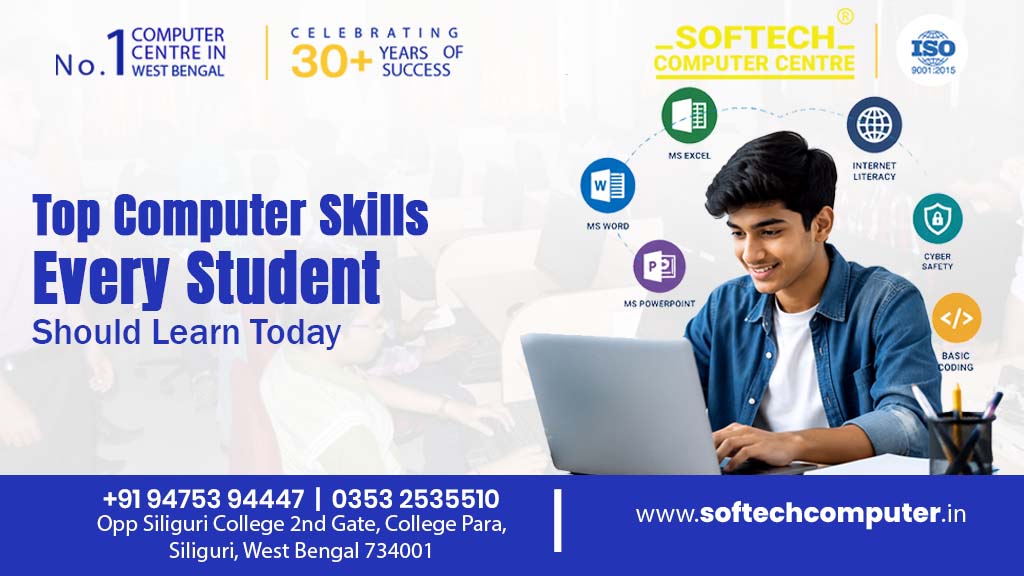
Top Computer Skills Every Student Should Learn Today
Top Computer Skills Every Student Should Learn Today Here is something no one tells you clearly enough in school. Your degree opens the door. Your skills decide whether you walk through it. In 2026, employers across every industry – IT, finance, healthcare, retail, education – are not just asking what you studied. They are asking what you can do. And the students who have built real computer skills are consistently the ones getting shortlisted, called back, and hired first. The good news? These skills are learnable. None of them require a technical background. And most of them can be built in a few months with the right training. Here is exactly what matters – and why. 1. Microsoft Office and productivity tools Before anything else, get this right. MS Word, Excel, and PowerPoint are used in almost every workplace in India – from small businesses to large corporations. Yet most students who claim to “know Office” can barely do more than type a document or make a basic slide. The students who stand out know Excel formulas, data sorting, pivot tables, and professional formatting. They know how to build a presentation that communicates clearly, not just one that looks busy. This is not a glamorous skill. But it is the one that comes up in literally every job, every day. 2. Basic Coding and Programming You do not need to become a software engineer to benefit from knowing how to code. Even basic programming knowledge – understanding logic, writing simple scripts, knowing how software thinks – changes how you approach problems. It makes you more valuable in roles that have nothing to do with development. For students who want to go deeper, Python is the best starting point in 2026. It is beginner-friendly, widely used, and relevant across data science, automation, AI, and web development. According to the TIOBE Index, Python has been the most popular programming language globally for three consecutive years. Start with the basics. Build one small project. The confidence that follows is worth more than any certificate. 3. Internet Research and Digital Literacy This sounds obvious. It is not. Most students can search Google. Very few know how to evaluate sources, cross-check information, use advanced search filters, or find reliable data for a report or project. Digital literacy also covers understanding how the internet works – basic cybersecurity awareness, recognising phishing attempts, protecting personal data, and using cloud tools like Google Drive and OneDrive effectively. These are skills employers test without announcing they are testing them. 4. Tally and Accounting Software Not just for commerce students. Tally with GST is one of the most consistently hired-for skills across small and medium businesses in India. Accountants, billing executives, GST assistants, and office managers all need it – and most candidates walking into interviews do not have it. If you are a commerce or arts graduate wondering how to make your resume more competitive immediately, a Tally course is one of the fastest, most practical answers available. 5. Graphic Design Basics Visual communication is now a professional skill – not just a creative hobby. Tools like Canva, Photoshop, and CorelDRAW are used in marketing, education, HR, content creation, and business operations. A student who can design a professional poster, social media graphic, or company presentation has an immediate practical advantage over one who cannot. You do not need to become a designer. You need to know enough to communicate visually – and that level is reachable in weeks, not years. 6. Data Handling and Spreadsheet Analysis Data is everywhere. Most people cannot read it. The ability to organise, analyse, and present data clearly – using Excel, Google Sheets, or basic SQL – is one of the most in-demand skills across industries in 2026. According to NASSCOM, data-related roles in India grew over 45% between 2022 and 2024. Students who can take a messy spreadsheet and turn it into a clear, actionable summary are immediately more useful than those who cannot. This skill alone has launched careers in finance, marketing, operations, and consulting. 7. AI Tools and Prompt Skills This one is new – and it is moving fast. AI tools like ChatGPT, Google Gemini, and industry-specific platforms are now part of everyday work in offices, agencies, and businesses of every size. Students who know how to use these tools effectively – to research, write, summarise, automate, and solve problems – are measurably more productive. Prompt engineering, the skill of communicating with AI systems to get accurate and useful outputs, is already a paid job title at major companies. At the beginner level, it is a skill any student can build in weeks. Ignoring AI tools in 2026 is the equivalent of ignoring the internet in 2005. 8. Typing Speed and Basic Computer Operation This still matters – more than most students admit. A typing speed of 40 to 50 words per minute is expected in most data entry, administrative, and office roles. Many government job examinations test it directly. Students who have never focused on typing speed often find themselves unprepared for timed tests and slow in day-to-day work. Basic computer operation – file management, keyboard shortcuts, system settings, printer and network setup – is the foundation everything else is built on. Do not skip it. Where to Build These Skills in Siliguri Knowing what to learn is only half the answer. Where you learn matters just as much. Softech Computer Centre in Siliguri is an ISO 9001:2015 certified computer training institute offering 50+ job-oriented courses covering every skill on this list – from MS Office and Tally to Python, AI, graphic design, and data handling. Courses are designed for students from any background, with experienced trainers, hands-on project work, and flexible batch timings. Over 30 years of training students across North Bengal. The results speak for themselves. Frequently Asked Questions What are the most important computer skills for students in 2026? The most in-demand computer skills for students in 2026 are MS Office proficiency, basic programming
Top Computer Skills Every Student Should Learn Today Read More »