


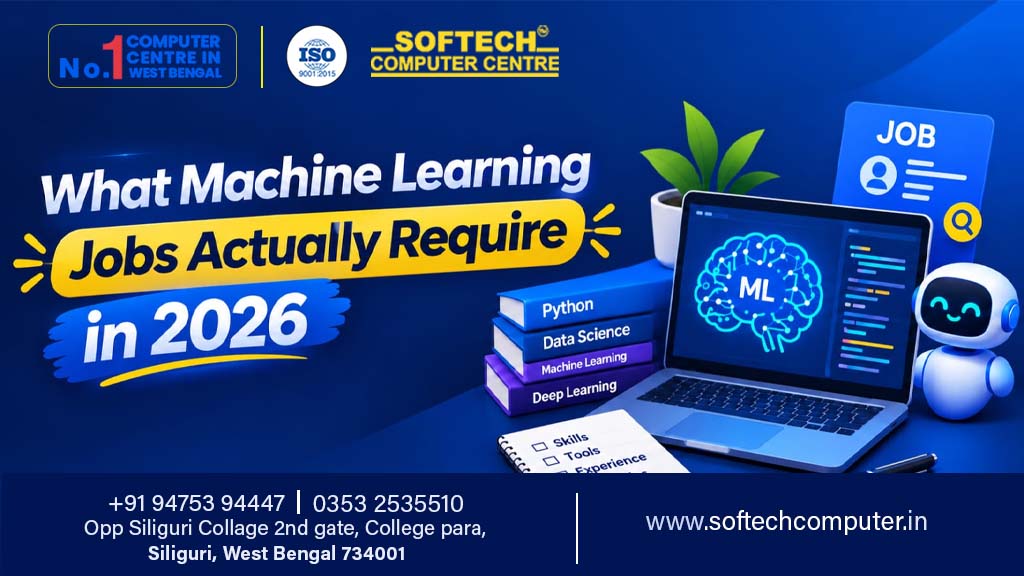
What Machine Learning Jobs Actually Require in 2026
Most people who want a machine learning job are preparing for the wrong thing.
They are watching complicated mathematics videos, reading research papers, and assuming they need a postgraduate degree before they can even apply. Meanwhile, companies across India are struggling to fill machine learning roles because the candidate pool is thin – not because the work is impossible, but because most people talk themselves out of it before they start.
This blog is a straight answer to the question most candidates never ask clearly enough: what do machine learning jobs actually require in 2026, at a level where real people get hired?
Softech Computer Centre is an ISO 9001:2015 certified Computer Centre in Siliguri with 30+ years of experience and 50+ courses – including an AI course in Siliguri built around the practical foundations that machine learning careers are built on.
What Machine Learning Actually is?
Before getting into requirements, it is worth being clear about what machine learning actually involves in a working context.
Machine learning is the process of training software systems to learn from data and improve their performance without being explicitly programmed for every scenario. In practice, this means building models that can predict outcomes, classify information, detect patterns, and make recommendations based on historical data.
In 2026, this work shows up across industries. Banks use it to detect fraud. Healthcare companies use it to predict patient outcomes. E-commerce platforms use it to recommend products. Logistics companies use it to optimise delivery routes. The applications are wide – and growing.
The jobs that support this work range from entry-level data roles to senior machine learning engineers. The entry point is more accessible than most people assume.
What Machine Learning Jobs Actually Require
Here is what employers are genuinely looking for – broken down honestly.
Python - non-negotiable
Every machine learning job in India lists Python as a requirement. Not as a preference. As a baseline.
Python is the primary language for machine learning work. Libraries like NumPy, Pandas, Scikit-learn, TensorFlow, and PyTorch – the tools that machine learning engineers use daily – are all Python-based. Without Python, you cannot work with any of them.
The good news is that Python is one of the most beginner-friendly programming languages available. You do not need to master every aspect of it. You need to be comfortable enough with Python to write scripts, manipulate data, and implement models using existing libraries.
Available through coding classes in Siliguri at Softech Computer Centre – taught from scratch, no prior experience required.
Mathematics - Enough, Not Everything
This is where most people panic unnecessarily.
Machine learning does use mathematics – linear algebra, statistics, probability, and calculus appear in the theory behind the models. But at the entry level, you do not need to derive algorithms from scratch. You need enough mathematical literacy to understand what a model is doing, interpret its results, and know when something has gone wrong.
Basic statistics – mean, median, variance, correlation – and an understanding of probability are more immediately useful for most entry-level machine learning roles than advanced calculus.
Data Handling and SQL
Machine learning does not work without data. And data, in the real world, is messy.
Entry-level machine learning roles spend a significant portion of time collecting, cleaning, organising, and preparing data before any model is built. SQL is the primary tool for querying and managing that data. Excel and Python’s Pandas library handle the rest.
Candidates who can work confidently with raw data – finding errors, handling missing values, restructuring formats – are immediately more useful than candidates who can only discuss model architecture.
Understanding of Machine Learning Fundamentals
You need to understand the concepts before you can apply them.
What is supervised learning? What is unsupervised learning? What is a classification problem versus a regression problem? What does overfitting mean and why does it matter?
These are not advanced topics. They are the vocabulary of machine learning – the baseline every employer assumes you have before an interview starts. A structured AI course in Siliguri at Softech covers these fundamentals practically, through real examples rather than abstract theory.
Communication and Problem Framing
This one is underestimated almost universally.
Machine learning engineers do not work in isolation. They work with business teams who need to understand what a model does, product managers who need to know what is and is not possible, and stakeholders who make decisions based on model outputs.
The ability to explain a technical concept clearly to someone without a technical background is a genuine skill – and one that significantly accelerates careers in machine learning beyond the entry level.
Skills That Actually Separate Candidates
Beyond the fundamentals, here is what makes the difference at the hiring stage:
A portfolio of real projects – employers want to see that you have built something. A model you trained on real data, a problem you framed and solved, a result you can explain and defend. One good project demonstrates more than a list of completed courses.
Familiarity with machine learning tools – Scikit-learn for classical ML, TensorFlow or PyTorch for deep learning, Jupyter Notebooks for development. Knowing your way around these tools signals practical readiness.
Basic understanding of version control – Git is used by every professional development team. Not knowing it is a gap that shows up immediately. The basics take days to learn.
Awareness of AI ethics and data privacy – increasingly expected at every level. Understanding why bias in training data matters, what responsible AI means, and how data privacy regulations affect model development puts you ahead of candidates who have only thought about the technical side.
Machine Learning Jobs You Can Actually Apply For
The term machine learning engineer covers a wide range of actual roles. Here is what entry-level candidates are realistically targeting:
Data analyst with ML exposure – the most popular route for entry-level positions. Data analysis and building basic prediction models using Python and SQL. Salary Range ₹4 to 7 LPA.
Junior machine learning engineer – building and evaluating models under senior guidance. Usually requires stronger Python and some project experience. Average salary ₹5 to 9 LPA at entry level.
AI/ML associate at product companies – working on specific applications of machine learning within a product. Common in e-commerce, fintech, and healthcare tech. Salary varies significantly by company.
Data science trainees at large IT companies – TCS, Infosys, Wipro, and similar companies run structured programmes that recruit freshers with foundational ML skills and train them further internally. A strong foundation course, good Python skills, and a real project are typically enough to be competitive here.
How long it actually takes to build these skills
This is the question nobody answers directly. Here is an honest estimate.
Python basics to working proficiency: 3 to 4 months of structured learning and consistent practice.
Statistics and data handling fundamentals: 1 to 2 months alongside Python.
Machine learning fundamentals and first project: 2 to 3 months after Python.
Total realistic timeline to job-ready foundation: 6 to 9 months of consistent, structured effort.
This is not a shortcut timeline. It is a realistic one. Students who try to compress this into a few weeks by watching videos without practising take significantly longer to get hired – or do not get there at all.
A structured programme that combines Python, AI fundamentals, and applied projects – like the AI course in Siliguri at Softech Computer Centre – compresses this timeline significantly compared to self-directed learning, because the structure, feedback, and progression are built in.
Can students from non-IT backgrounds build a machine learning foundation?
Yes – and this matters for the majority of students in North Bengal who did not study computer science.
Machine learning work is split roughly between technical implementation and analytical thinking. The analytical side – understanding problems, interpreting results, communicating findings – is not exclusively a computer science skill. It is developed across commerce, science, and even arts backgrounds.
Python is learnable by any student willing to practise. Statistics is familiar territory for commerce students. Data handling builds on skills that any analytically-minded person can develop.
The barrier is not background. It is finding a starting point that takes you seriously wherever you are. That is what the coding classes in Siliguri at Softech are designed to do – meet students at their actual level and build from there.
Frequently Asked Questions
What qualifications do you need for a machine learning job in 2026?
Is machine learning hard to learn from scratch?
Where can I start building a machine learning foundation in Siliguri?
How is machine learning different from AI?
The Foundation Is What Most People Skip
The candidates who get hired for machine learning roles in 2026 are not necessarily the most mathematically gifted or the ones with the most expensive degrees.
They are the ones who built the right foundation – Python, data skills, ML fundamentals, and real projects – and showed up to interviews with something concrete to talk about.
That foundation is buildable. It takes six to nine months of structured, consistent effort. And it starts with one decision to begin.
Softech Computer Centre in Siliguri offers the AI course, the coding classes, and the structured environment to build that foundation properly – with experienced instructors, real project work, and support that continues after the course ends.
ISO 9001:2015 certified. 50+ courses. 30+ years across North Bengal. Admissions open.
Visit www.softechcomputer.in or walk in and speak with the team directly.