


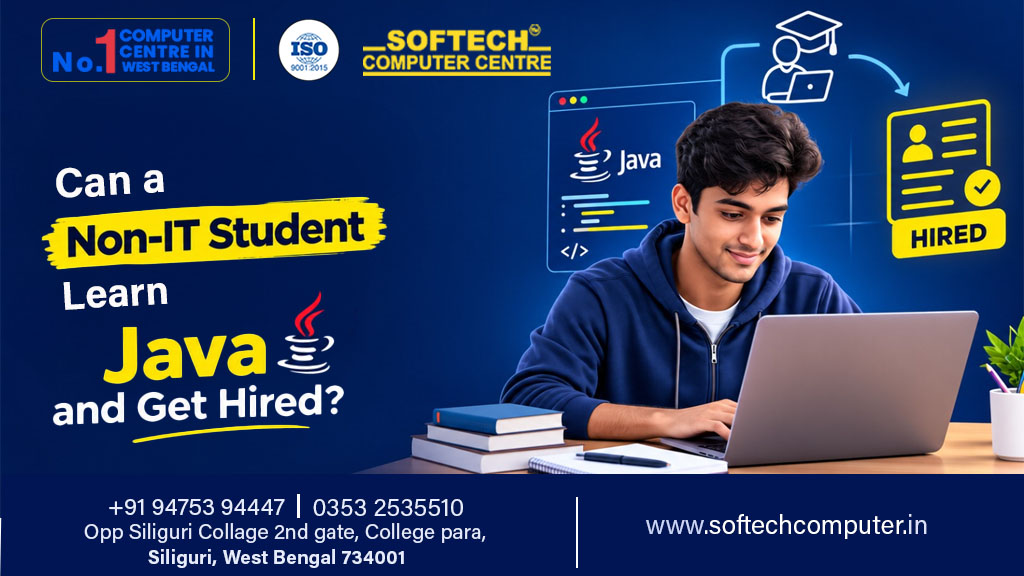
Can a Non-IT Student Learn Java and Get Hired?
Short answer – yes.
Longer answer – yes, but only if you stop believing the myth that coding is reserved for people who studied computer science.
That myth has cost more students more opportunities than any lack of technical ability ever has. Commerce graduates, arts students, BCom holders, and professionals from completely unrelated backgrounds are completing Java courses and walking into software interviews every year. Not as an exception. As a growing pattern.
This blog is for anyone who has looked at a Java course and thought – that is probably not for someone like me.
It is. Here is why – and more importantly, here is how.
Softech Computer Centre is an ISO 9001:2015 certified Computer Centre in Siliguri with 30+ years of training experience and 50+ courses. The Java course here is taken by students from every academic background – and the ones who show up consistently are the ones who get hired.
Why People Think Coding Is Not for Them
The idea that coding is only for engineers did not appear from nowhere.
For a long time, programming was taught almost exclusively inside computer science and engineering degrees. The tools were complex, the syntax was unforgiving, and learning resources were limited to textbooks that assumed a technical foundation most people did not have.
That world no longer exists.
In 2026, Java is taught in structured beginner courses designed specifically for people with no prior coding experience. The language has not become simpler – but the way it is taught has improved dramatically. Good instructors now teach Java the way it should always have been taught – starting with thinking, not syntax.
The real requirement for learning Java is not an engineering degree. It is the ability to follow a logical process, break a problem into steps, and practise consistently. Commerce students do the first two every time they work through an accounting problem. Arts students do it every time they construct an argument. The thinking is the same. Only the language is new.
Three Things That Matter More Than Your Degree
Not your degree. Not your board percentage. Not whether you studied science or commerce or arts.
These three things determine whether you learn Java and get hired:
Consistency – coding is a skill built through repetition. Students who show up every session, practise between classes, and build projects throughout the course consistently outperform students who try to catch up at the end. Background is irrelevant. Attendance is not.
Willingness to be wrong – every programmer, at every level, writes code that does not work before they write code that does. The students who progress fastest are the ones who treat errors as information rather than failure. This mindset is learnable. It is also more natural for non-IT students who have not been taught to fear getting the answer wrong in a computer class.
The right course structure – a beginner Java course that starts with object-oriented concepts without explaining the underlying logic first will lose any student, IT background or not. The Java course in Siliguri at Softech Computer Centre is built around gradual progression – fundamentals first, complexity later, real projects throughout.
What the Java course at Softech actually covers
At Softech Computer Centre in Siliguri, the Java course is not designed for people who already know how to code. It is designed for people who want to learn.
Here is what the course covers – in plain language:
Core Java fundamentals – the building blocks. Variables, data types, operators, and control flow. How Java thinks. How you make it do what you want. This is where every student starts, regardless of background.
Object-oriented programming – the concept that makes Java both powerful and hireable. Classes, objects, inheritance, and encapsulation. Taught not as abstract theory but as a way of organising real-world problems. Once this clicks, everything else builds on it naturally.
Data structures and collections – how Java stores and manages information. Arrays, lists, maps, and stacks. These show up in almost every interview question at the fresher level, and knowing them well is the single most reliable way to get through a technical screen.
Exception handling and debugging – how to find out why your code broke and fix it. This is not a minor topic. It is what separates a trained developer from someone who only writes code when everything goes right.
Real projects throughout – not a single project at the end as a box-ticking exercise. Working on actual tasks across the duration of the course is what builds the portfolio and the confidence to talk about it in an interview.
Interview preparation – mock tests, coding challenges, and repeated exposure to the problem formats that Java interviews in India consistently use. By the time students finish the course, a technical interview does not feel like a test. It feels familiar.
Java Jobs in India - What Freshers Can Expect
Understanding what is available is as important as understanding whether you can get there.
Java developer roles in India grew by over 22% between 2022 and 2024 according to industry hiring data. Entry-level salaries for Java developers sit between ₹3 and 6 LPA. Two to three years of experience moves that into the ₹8 to 15 LPA range.
More importantly for non-IT students – the sectors hiring Java developers are not exclusively startups or IT services companies. Banking and financial services, insurance, healthcare technology, logistics, and government IT all hire Java developers in significant volume. These sectors actively value candidates who understand business processes alongside code – which is exactly the combination a commerce or business student brings.
TCS, Wipro, Infosys, and HCL all recruit Java developers at the fresher level. So do hundreds of mid-size companies across India that never make headlines but consistently hire trained candidates from institutes like Softech Computer Centre.
What Happens After - Real Career Paths
This is not theoretical. Students from non-technical backgrounds complete the Java course at Softech and go into real roles. Here is what those paths typically look like:
Commerce graduate → Junior Java Developer at a fintech company – knowledge of financial processes combined with Java skills makes candidates immediately useful in banking software teams that need people who understand both sides.
Arts graduate → QA Engineer – quality assurance in software development does not require deep coding expertise, but it does require Java knowledge for writing test scripts. A well-prepared Java course opens this door reliably.
Non-technical professional → IT support and operations – understanding Java at a working level is increasingly expected in IT support roles that involve maintaining and troubleshooting Java-based enterprise systems.
Any background → Freelance developer – many students begin taking small development projects within months of completing the course. Client websites, simple automation tools, and small business applications are realistic starting points.
How Softech Teaches Java to Non-IT Students
There are coding classes in Siliguri across the city. Not all of them are designed with non-IT students in mind.
At Softech Computer Centre, the approach is different in one specific way – the course assumes you are starting from zero and builds accordingly. Nothing is glossed over because it seems obvious. Nothing is skipped because it is not interesting enough to cover quickly.
For non-IT students, this matters more than anything else. The gap between following a lecture and actually understanding what you just learned is where most beginner courses lose people. Small batch sizes mean doubt-clearing happens in the session – not at home alone with a search engine.
Instructors at Softech have worked in software development. They know what interviewers actually ask because they have been on both sides of that conversation. That knowledge comes through in how interview preparation is built into the course rather than added as an afterthought.
And for students who want to combine Java with other skills – an AI course in Siliguri, Python, web development, or Tally – Softech’s 50+ courses mean that combination is available under one roof without switching institutes.
Frequently Asked Questions
Can a non-IT student really learn Java and get a software job?
Is Java hard to learn for someone with no coding background?
How long does the Java course in Siliguri take?
What jobs can a non-IT student get after a Java course?
Should I combine Java with any other course?
Where can I do a Java course in Siliguri?
Stop Waiting. Start Learning
Every programmer was a beginner once. The ones who came from non-IT backgrounds did not succeed because the course was easy. They succeeded because they stopped waiting for permission to be in the room.
The Java course in Siliguri at Softech Computer Centre is built for students who are starting from zero – whatever that zero looks like. Commerce student. Arts graduate. Working professional. Someone who just decided today that they want to learn.
The door is open. Whether you walk through it is the only question left.
ISO 9001:2015 certified. 30+ years across North Bengal. 50+ courses. Admissions open.
Visit www.softechcomputer.in or walk in and speak with the team directly.